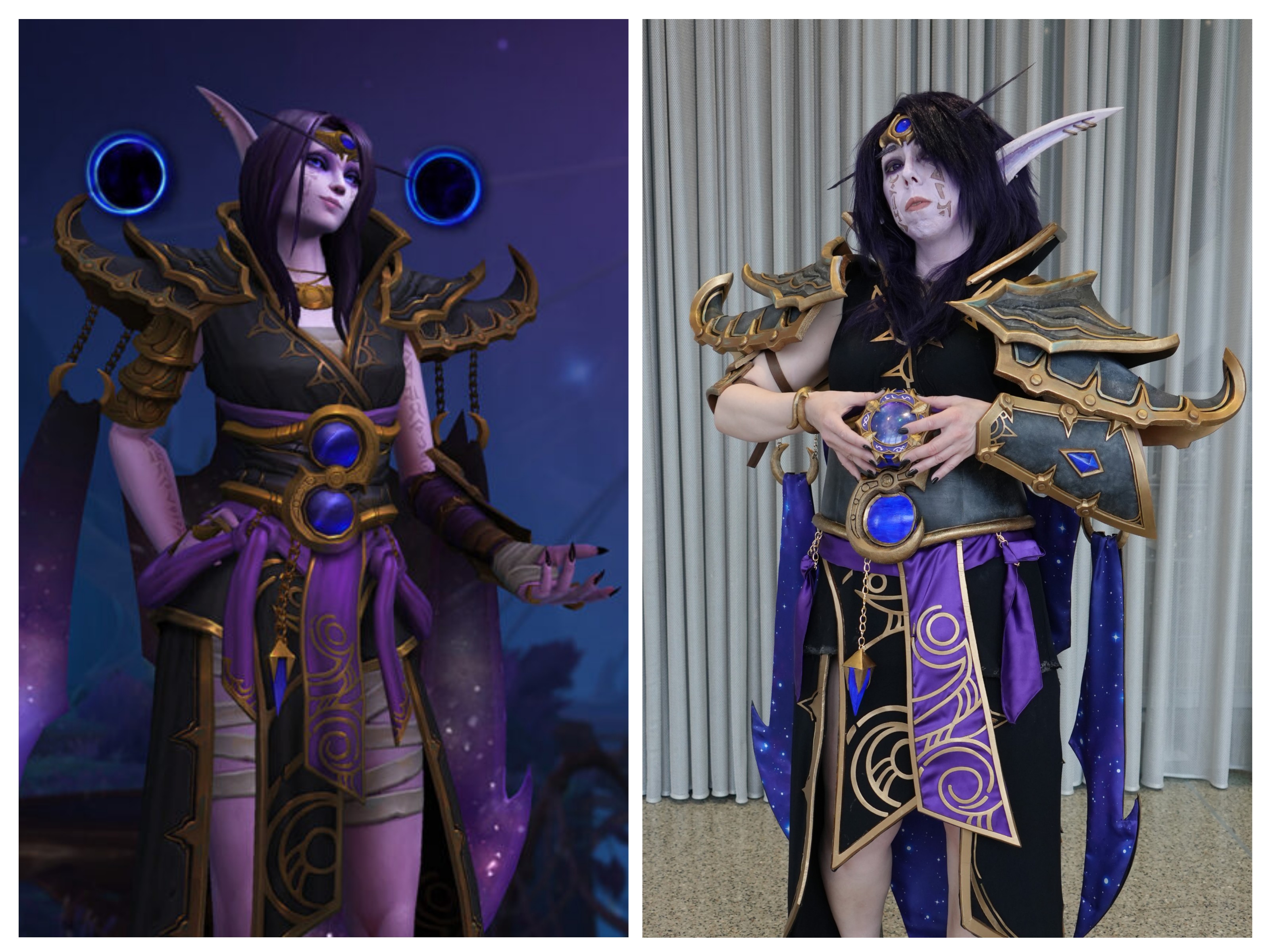
Getting this close to the design was incredibly rewarding — but wearing the costume for an entire convention revealed several things that only real-world testing can show.
After Emerald City Comic Con, I realized there were two different ways to think about the costume.
One is emotional: the excitement of finally becoming the character, the reactions from people, and the experience of wearing it in the real world.
The other is practical: how the costume actually performed as a physical system.
This post focuses on the second part.
Cosplay that looks good in a workshop doesn’t always behave the same way in a crowded convention center. ECCC was the first real stress test for the Xal’atath build, and it revealed a lot about what worked, what failed, and what needs to change before BlizzCon.
Overall Outcome
For a first full convention wear, the costume succeeded at its most important goal: it looked like the character.
Even when people didn’t know the name, they could usually tell it was from World of Warcraft. And when someone did recognize Xal’atath, the reactions were incredibly rewarding.
But ECCC also exposed several structural weaknesses. Some components broke, some attachment methods weren’t strong enough, and certain design choices made movement through crowded spaces more difficult than expected.
None of these problems are unusual for a first convention wear. In many ways, this was exactly what the event was supposed to be: a full-scale test before the next major convention.
What Worked Well
Several parts of the build performed exactly as intended.
Silhouette and visual impact
The overall silhouette translated extremely well in person. The wide pauldrons, layered armor shapes, and iconic components made the costume recognizable even from a distance.
Character recognition
Even when people weren’t completely sure of the character’s name, many recognized the design from World of Warcraft. And when someone called out “Xal’atath,” it was immediately clear that the build had achieved its goal.
Makeup and character presentation
The makeup, tattoos, and overall character presentation held up surprisingly well throughout the day and photographed nicely.
Comfort without the pauldrons
Ironically, the night the pauldrons broke ended up revealing something useful: the rest of the costume was actually quite comfortable to wear for extended periods.
Structural Failures
The convention also revealed several structural weaknesses.
Pauldron attachment
The pauldron system failed multiple times during the convention. The foam that attached the ring separated from the main part. This occurred while I was trying to fix my ear in the bathroom — the pauldron twisted in just the right way and the attachment point popped apart.
This is the single most important issue to redesign before BlizzCon.
Corset zipper
The zipper in the foam corset failed during dressing on Saturday morning and had to be replaced.
This suggests the closure system needs to be reinforced or redesigned for durability.
I had the idea (what I thought was a good idea at the time) to laminate a 2 mm foam layer over the existing 5 mm foam in order to hide the seams. But this ended up making the corset lose its curves, becoming thicker and tighter. It originally erred on the side of being slightly too big, but after the added foam layer I was squeezing into something that no longer fit correctly.
It was probably only a matter of time before the zipper would fail.
For the record, it didn’t break where it was sewn into the corset — the zipper actually separated from the pull.
Ear attachment
The elf ear attachment method also failed under normal movement and adjustments. Each ear had a bobby pin that was supposed to slide into the wig to hold it upright. I had difficulty finding the correct angle and difficulty getting the pin to stay in place.
Eventually I had the bobby pin glued on in the cosplay repair room.
A more stable mounting method will be required for future wears.
Durability Concerns
Several areas did not fail outright but showed signs of potential weakness.
- chain attachment points on foam pieces
- temporary velcro used during construction
- stress points where foam components connect to hardware
These areas will likely need reinforcement during the next iteration of the build.
Mobility and Wearability
Large armor dramatically changes how you move through real spaces.
Wide pauldrons made navigating doorways, stairs, and crowded aisles significantly more difficult. Artist Alley in particular proved challenging because of the narrow walkways.
Sitting was also more complicated than I expected. Because of the layered foam pieces, I was constantly worried about crushing parts of the armor — either by sitting on them myself or by someone bumping into them while walking by.
During the cosplay contest I ended up taking three chairs. Between the pauldrons and the layered armor pieces splaying outward, there wasn’t really a normal way to sit. I ended up perched awkwardly on the edge of one chair while trying to keep the armor from getting squished.
These are not necessarily problems to “fix,” but they are important realities to plan for when wearing the costume at future conventions.
Dressing Process
Originally, one of my goals was to design the costume so that I could put it on myself.
In practice, that turned out to be unrealistic for a build of this complexity.
Getting assistance with dressing made the process much faster and significantly reduced the risk of damaging pieces during assembly.
What Surprised Me
Several things about the experience were unexpected.
First, even when parts of the costume broke, people still recognized the character. The overall design was strong enough that missing pieces did not completely break the illusion.
Second, wearing the costume outside the convention center produced some of the most memorable reactions. People who had no idea what the character was still reacted strongly to the visual impact.
Finally, the convention reinforced something that many cosplayers already know: the first public wear of a costume is rarely the final version.
Immediate Repairs Needed
Before the costume is worn again, several repairs are necessary:
- redesign and reinforce pauldron attachments
- reinforce chain mounting points
- stabilize elf ear attachment method
- ensure the corset closure system is reliable
Looking Toward BlizzCon
BlizzCon is about six months away.
That means this build now enters a new phase: refinement.
ECCC served as the first full test of the costume in a real convention environment. Now the goal is to improve durability, strengthen structural components, and refine details so the costume performs better during future events.
Version one succeeded in bringing the character to life.
Version two will focus on making sure the armor can survive the battlefield.
In the next post, I’ll break down each part of the costume piece-by-piece and outline the upgrades planned before BlizzCon.