I said I was going to apply to the BlizzCon cosplay exhibition. You know, the event where you walk across the stage looking badass without judges meticulously inspecting your seams and paint job under bright lights.
I looked at the rules, and it asked for things like:
- Sketches and work-in-progress photos
- A list of supplies
- A timeline explaining how you’ll finish the costume within the next four months
So that’s what I started doing.
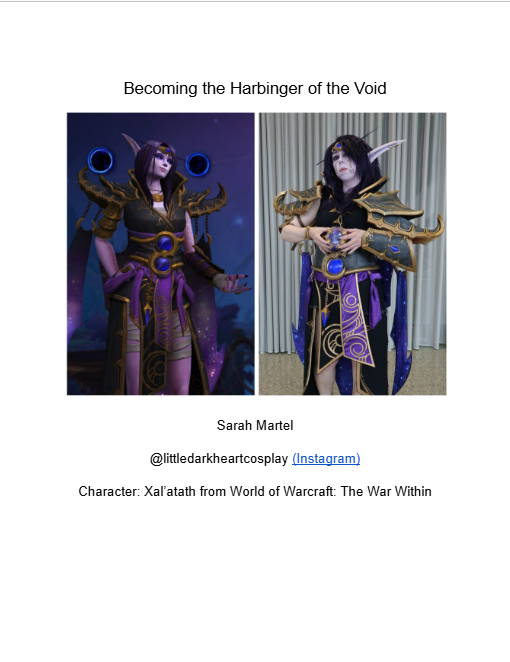 IDK who writes an essay voluntarily
What began as a few notes turned into a giant Google Doc full of photos, links, timelines, materials, engineering plans, math, repair notes, and enough information for someone else to probably build the cosplay themselves.
 Yes, it’s 30 pages, but TO BE FAIR, I insisted on spacing and sections on new pages!
And then I reread the rules.
Turns out all of that was only required for the contest. Not the exhibition.
Meanwhile, cosplayers in Discord were submitting a single photo collage because that was apparently enough for exhibition applications.
If only I had read the directions the first time.
Instead, I looked at my accidental thesis and said:
“Fuck it. I’m entering the contest.”
Honestly, though? I think this ended up being a good thing. I now have a far more detailed roadmap than I would’ve had if I’d just submitted a few photos and moved on. So now I’m going to explain how I’m using this monster of a document to actually finish the build.
How I Organized My Xal’atath Thesis
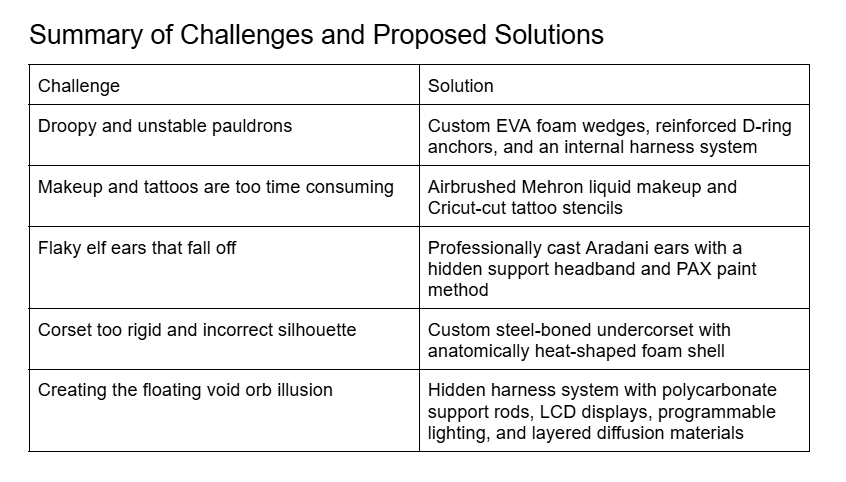 These are like my raid bosses that I need to focus my time and energy on
I genuinely think I could have written an actual thesis with the amount of planning and analysis that went into this thing.
To stop myself from getting overwhelmed, I broke the document into sections based on the contest requirements:
- Introduction
- The Evolution
- Summary of Challenges and Proposed Solutions
- Pauldrons
- Makeup/Tattoos
- Ears
- Corset
- Void Orbs -Components Rated on Completion Status and Difficulty
- Component Deep Dives
- What I’m Building and Why
- How I’m Making It
- Problem Solving and Upgrades -Technical Components
- The Dark Heart
- Void Orbs
- Structural Engineering
- Electronics and Lighting Design
- Materials
- Resources
- Timeline
Introduction
The purpose of the introduction was simple: if the judges only looked at the cover page and skimmed the intro, I wanted them to immediately understand the vision.
I started by explaining the evolution of the costume. This isn’t a brand-new build. It’s a rebuild. Version 1.0 already existed, but actually wearing it at Emerald City Comic Con exposed all the weaknesses, repair needs, comfort problems, and missing components.
Some pieces survived the con floor. Some absolutely did not.
I also identified the five biggest challenge areas. These are the components most likely to eat time, require experimentation, or involve learning entirely new skills and materials. Those are the pieces I need to start early instead of leaving until the final panic-filled weeks before BlizzCon.
Finally, I rated every costume component based on completion status and projected difficulty. The scoring was heavily inspired by my post-con damage report and prioritization matrix posts
Not bad considering only 25% completion was required.
Component Deep Dives
This section became the bulk of the document.
Instead of discussing every costume piece individually, I grouped related components together. The dress, corset, collar, and harness became one section. The cape, belt, and side flaps became another.
For each group, I explained:
- What existed in Version 1.0
- What happened after actually wearing it at Comic Con
- How I originally built it
- What I’m changing for Version 2.0
- The problems I need to solve moving forward
Every section included progress photos, repair photos, prototypes, or references.
Honestly, if I hadn’t forced myself to keep up with my What The Hell Have I Been Doing? accountability blog series, I would barely have any progress photos to use at all.
Technical Components
The Dark Heart and the void orbs got their own dedicated section because they’re honestly their own category of insanity.
The Dark Heart is already complete and fully functional, so that section focused more on the engineering decisions, electronics, battery life, and software.
The void orbs, meanwhile, barely exist outside my brain right now.
Those sections included:
- Structural harness concepts
- Polycarbonate support rod planning
- LCD screen concepts
- Lighting diffusion ideas
- Wiring plans
- Electronics architecture
I even included a video clip of the Dark Heart working and linked the GitHub repository for the code because apparently we’re doing software engineering now too.
The funniest part is that the void orb section might be the most ambitious thing in the entire document despite currently existing as:
- sketches
- diagrams
- shopping lists
- delusions
- and pure confidence
I haven’t even started building them yet.
Materials
I included a materials section with links to the major supplies, patterns, electronics, paints, contacts, fabrics, and tutorials I used throughout the build.
A complete materials list would probably become its own separate document, so I focused on the most important or unusual components instead.
The judges probably do not need to know every adhesive I emotionally bonded with over the past several months.
Resources
The researcher part of my brain absolutely refused to skip citations.
I included tutorials, references, my primary source images, and the creators who inspired or helped me throughout the process. If I learned a technique from someone else, I wanted to acknowledge it.
Also, if I’m going to accidentally write a thesis, apparently I’m going to include sources too.
Timeline
Last but definitely not least: How the hell am I going to finish this in four months?
Four months feels abstract and terrifying. Two-week sprints feel manageable.
So I broke the project into sprint cycles with one or two major focus areas at a time. No more than that.
This week’s focus is:
- the ears
- the Blade of the Black Empire
Not every sprint item has to belong specifically to Xal’atath. Sometimes the goal is simply keeping momentum.
The smaller tasks live on my whiteboard, in my planner, or both. My system isn’t elegant, but if something gets written down somewhere, there’s a much higher chance it actually gets done.
Seeing everything organized into sections makes the project feel less like an impossible mountain and more like a series of solvable problems.
 WTF did I just do?!
The Easy Part Was Writing the Essay
I thought I would feel relieved after finally submitting the application.
Instead, I felt dread.
Like I had just completed the “easy” part: writing down plans, notes, diagrams, and ideas.
Now I actually have to build the damn thing.
But honestly? I think this is exactly the kind of structure I needed. The accountability systems, the sprint planning, the damage reports, the progress tracking…all of it exists because I know how easy it is to get overwhelmed by a project this large.
I’m still intimidated by it.
But I also know I’m going to finish with a sick cosplay.